

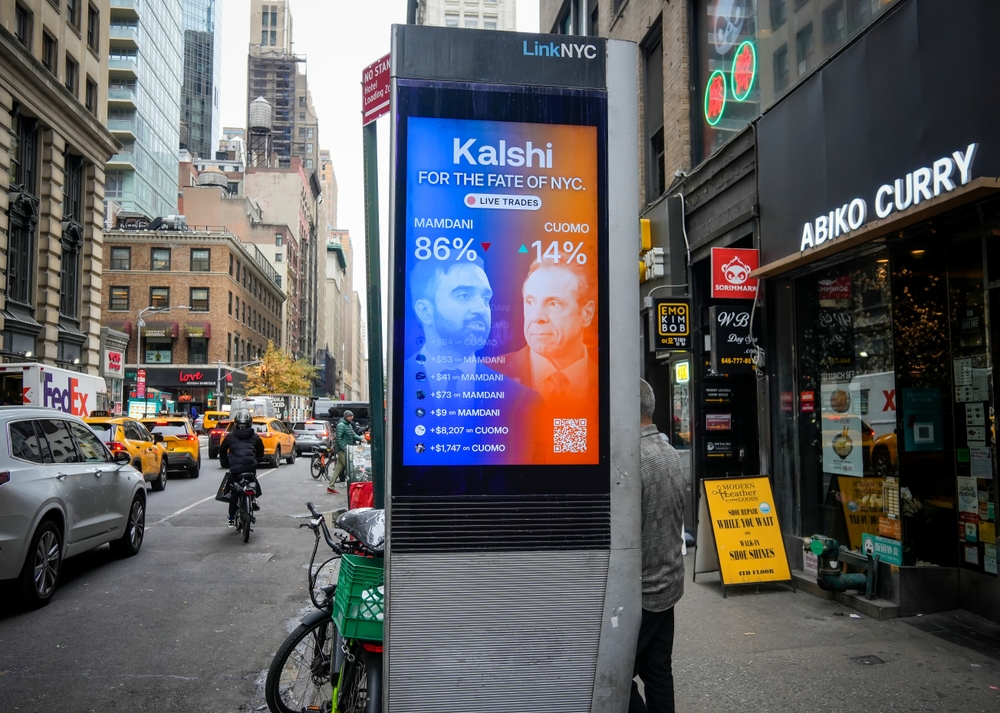
Barely three months ago, when it sought to raise US$1 billion in funding, prediction markets pioneer Kalshi was valued at US$11 billion. Now, along with its principal rival, Polymarket, it’s pitching a valuation twice that – an astonishing US$20 billion.
Swatting aside a clutch of legal restraints, ongoing court cases and continued controversy over whether they constitute “gambling” or “outcomes on events”, the Manhattan-headquartered New World iGaming (NWiG) sites have now gone back to the moneymarkets seeking even more mega investment based on their latest self-valuation of US$20 billion (£14.97bn).
Founded by MIT (Boston’s elite Massachusetts Institute of Technology) grads Tarek Mansour and Luana Lopes Lara in 2018, Kalshi has emerged as seemingly bullet-proof and, arguably, the hottest brand in contemporary iGaming, ranging well beyond the traditional Futures brief and now disrupting the lucrative world of U.S. sports betting.
Only last December it raised US$1 billion (£740m) from a bevy of investors, including crypto-focussed Paradigm and inter-connected Sequoia Capital, on a valuation of US$11 billion (£8.23bn).
No Done Deals…But
Highly-placed sources in New York-based venture capital funds, who asked for anonymity, confirmed that both Kalshi and Polymarket are now aggressively looking for further investment in their ventures.
“As yet there are no done deals,” I was told. “But based on their fiscal trajectory, the market is putting their current valuation at around US$20 billion.
“So this is the valuation we’re working towards.”
Polymarket, founded in 2020 by Shayne Coplan, was valued at US$9 billion (£6.74bn) last October when New York Stock Exchange owner Intercontinental Exchange agreed to invest up to US$2 billion (£1.49bn) in the Futures app – weeks before it was re-regulated and acquired a licence to operate as a derivatives exchange by the federal government’s regulatory Commodity Futures Trading Commission (CFTC).
Fame and Infamy
It’s estimated that Kalshi–which shot to fame by correctly predicting Donald Trump’s return to the presidency–is currently generating revenue of some US$1.5 billion a year (£1.12bn).
Kalshi has recently signed a data deal with broadcaster CNN; while Polymarket has a data partnership with Rupert Murdoch’s Dow Jones, financial publisher of the Wall Street Journal, Barron’s, MarketWatch, et al.
The rise of Kalshi, Polymarket and other prediction markets, such as Robinhood, has caused widespread consternation and disruption in the U.S. online sports betting market, as the NWiGs have widened their ambit to embrace outcomes on all of the nation’s major sporting events.
Traditional sportsbook Big Two players FanDuel and DraftKings, for example, have rushed to launch prediction apps of their own, FanDuel Predicts and DraftKings Predictions.
And insider trading allegations–particularly focussed on Polymarket–concerning predictions on recent international events over the kidnapping of Venezuelan dictator Nicolás Maduro and bombing of Iran have led to calls to ban the NWiGs from taking bets on war, as well as sports.
Watch this space!