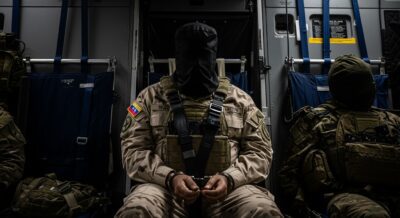
EXCLUSIVE: The seizure and sequestration of Venezuelan strongman Nicolás Maduro by U.S. Special Forces opens up unique opportunities for the oil-rich nation’s little-known gambling sector, where there are casinos but online betting is mostly done with authorized offshore operators in places like Curaçao.
According to highly-placed Venezuelan fiscal sources, contacted by iGamingFuture in the aftermath of Saturday’s daring kidnapping of Maduro, the leader of the leftist Chávista revolutionary party that has ruled the South American country since 1999, this opening will depend on the economic, political, and regulatory stability that his successors manage to establish in a country deeply divided by politics – in a transition that is still undefined.
The key for the sector, these sources told me, is how quickly Venezuela’s international isolation can be reduced, sanctions lifted, banking access opened, and foreign investment attracted so that an iGaming and sports betting industry can emerge.
The best-case scenario for this would be an orderly transition with full international recognition.
Payments and liquidity will improve rapidly if a new government achieves broader sanctions relief and restores the confidence of correspondent banks.
Sanctions
This will make it easier for operators and providers to move money, onboard PSPs, settle affiliates, and operate with cleaner card and wallet channels.
The sanctions against Venezuela are administered by the Office of Foreign Assets Control (OFAC), a division of the U.S. Treasury Department, which can decide which financial institutions and providers are willing to operate in the market.
In an orderly transition, a real and transparent framework for online gaming, which does not exist today, is more likely to be established.
Venezuela–the country with the largest proven reserves of petroleum in the world, estimated to be in excess of 300 billion barrels–has an established legal framework for land-based gambling with the 1997 law that allowed casinos to operate. And there is a structure with a national commission that regulates casinos, bingo halls and slot machines, but the online market has long had an irregular situation dominated by uncertainty and the country’s economic crisis.

A transitional government focused on generating tax revenue is expected to promote clear licensing for iGaming and sports betting.
This would reduce the current country risk, attracting large international operators, certified platform providers, and audited local partners, instead of the current black market.
Few gambling companies are formally established in Venezuela with local licenses. Most activity takes place through offshore platforms and on the black market.
Multinational companies such as BetWinner, Melbet, 1xBet, Stake, bet365 accept Venezuelan players, but operate with offshore licenses.
“Looking ahead, any significant resurgence of private gambling activity in Venezuela will depend on broader institutional and legal structures, including greater legal certainty and protection for investors,” Lay-Yun García Kong, a legal consultant specializing in gambling and betting regulation in Spain and Latin America, told iGamingFuture.
“Without these structural changes, Venezuela remains a market with latent demand, but with limited conditions for sustainable investment,” she argued.

Latent Demand
A real opening of the gambling market in Venezuela would also require an update to the advertising rules, because the current law prohibits it.
The Maduro government’s push to reopen casinos and bingo halls in 2020–2021, after a decade-long ban imposed by Hugo Chávez in 2011, demonstrates that gambling has been used as a lever for hard currency and tourism.
Therefore, it’s safe to expect that any successor government would also view gaming as a fiscal tool and establish more transparent regulations.
The land-based gambling market in Venezuela is very small compared to other Latin American countries.
According to available data, casino revenues average around US$4 million per year (£2.97m), a minimal figure regionally.
Currently, five casinos operate in the country. And, historically, the market has been limited by strict regulations and Venezuela’s economic difficulties.
Meantime, because it is unregulated, it’s impossible to quantify the online gambling market or the sector’s gross revenue per share (GGR).
Boom Days
Online casinos and sports betting sites are neither legal nor regulated, creating a grey area where players seek out offshore platforms.
Local sources indicate that there is a growing interest in iGaming among Venezuelan players, driven by mobile use and the scarcity of face-to-face entertainment alternatives, but there is no solid local infrastructure.
However, agreements between international providers and local platforms, such as Booming Games with JuegaenLínea, reflect a growing strategic interest in the Venezuelan player, despite regulatory uncertainty.

JuegaenLínea is one of the largest online casino operators in Venezuela, offering sports betting, casino games, and other typical iGaming products (slots, live dealer, et cetera). Its Founder and CEO, Gerardo Alcega, spearheaded Booming Games’ expansion in Latin America through JuegaenLínea, primarily in Venezuela.
Another very active online casino and sports betting platform in Venezuela is MiCasino, which is based in Caracas but operates under a gaming license issued in Curaçao. It offers welcome bonuses in bolivars, nominally Venezuela’s national currency, and special promotions for the Venezuelan market.
Back in the 1970’s and early 80s, thanks to the then-oil boom, Venezuela was, per capita, the richest country in the world.
Venezuelans were famous–if not infamous–for their mega spending: Drinking Black Label whiskey like wine, enjoying weekend shopping sprees to Miami and attracting millions of fellow Latin Americans to service their booming economy.
If the current U.S. intervention pans out and brings back political stability those days of good fortune may return and engender a vibrant iGaming industry.