
New data from Blask reveals a divide in how players search for iGaming products worldwide. In the United States, most searches are generic (“online casino,” “sports betting”) because players are still comparing options and have not settled on an operator. In Serbia, nearly all searches name a specific operator directly: players already know where they are going. The findings come from Blask’s Maturity Index, a new feature that measures this split across more than 50 markets for Jan–Mar 2026.
What the Maturity Index shows
Maturity Index is a new metric in Blask, now available for 50+ markets the platform covers. It gives operators and marketing teams a single number that shows how iGaming demand in a country divides between two types of intent.
The first type is generic category search: queries like “online casino,” “sports betting,” or “casino bonus,” where the player has no specific operator in mind. These users are still exploring — they can be reached through SEO, content, and category advertising.
The second type is brand-directed search: queries that name a specific operator, such as “Bet365,” “Betano,” or “DraftKings.” These users have already made a choice. They are navigating to a known destination, not comparing options.
The index maps the ratio between these two demand layers on a scale from 0 to 100. A score of 100 means all iGaming searches in a market are generic. A score of 0 means all searches name a specific operator. Fifty is an equal split.
For teams planning market entry or setting acquisition budgets, the score answers one practical question: how much of this market’s demand is still open to competition? A high score means a larger share of users is reachable through category channels — SEO, content, and generic paid search. A low score means brand equity already determines where most players go, so retention and brand investment produce stronger returns than category acquisition.
“The metric is most useful for teams making market-entry and budget decisions: which countries to prioritise based on how demand is structured, whether to lead with brand spend or category and SEO investment, how large a budget category competition actually requires, and how fast the balance between brand and category search is shifting over time,” said Ilya Batcherikov, Chief Product Officer at Blask.
A divided global picture
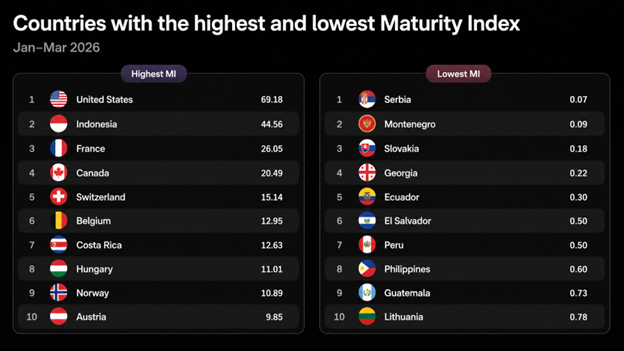
Across Jan–Mar 2026 data, the United States scores 69.18 — the highest of all markets Blask tracks. Its position is partly structural: lottery-related searches, which rarely include operator names, account for a large share of iGaming search volume in states where commercial online gambling is not yet licensed. That limits direct comparison with non-lottery markets. The score has also been declining since a peak of 87.4 in July 2023, as branded operators expand their presence.
Indonesia (44.56) is the only other market approaching the US range. No operator there has built the brand recognition needed to shift search behavior, so players search for product types rather than names.
France (26.05), Canada (20.49), Switzerland (15.14), Belgium (12.95), and Costa Rica (12.63) sit in the mid-high band — regulated markets with established operators that still retain enough category-level search for SEO and content to generate real acquisition volume. Hungary (11.01), Norway (10.89), and Austria (9.85) complete the top ten.
At the other end, Serbia (0.07) and Montenegro (0.09) record the lowest scores globally. Virtually all iGaming search in both markets is directed at specific operator names. Slovakia (0.18) and Georgia (0.22) follow. In these markets, category-based acquisition faces a structural ceiling regardless of budget.
Latin America shows a similar split within the region. Ecuador (0.3), El Salvador (0.5), and Peru (0.5) cluster at the brand-driven end. Brazil falls outside the top and bottom ten; its low score reflects the 2024–2025 regulatory consolidation, when licensing requirements narrowed the competitive field and operators including Betano and Bet365 captured most branded interest. The Philippines (0.6), Guatemala (0.73), and Lithuania (0.78) complete the ten most brand-directed markets.