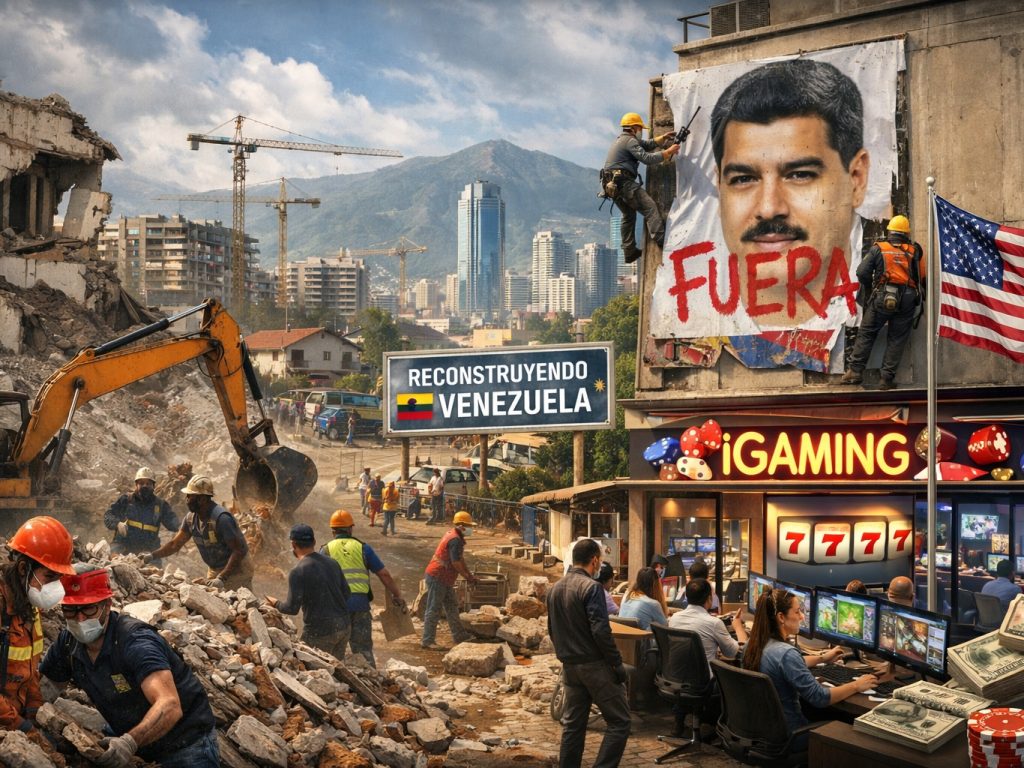
SPECIAL REPORT: The removal of former Chávista president Nicolás Maduro by the United States in January opened up huge opportunities for international iGaming and gambling companies in the little-known Venezuela market, as it quickly led to the lifting of the financial blockade that prevented investment and international payment systems.
But the enthusiasm for the great potential in a locally-driven addressable market of nearly six million bettors and an estimated annual GGR of about US$250 million (£185.83m) was thwarted on June 24 by two terrible earthquakes that devastated the coast of Caracas and left 5,200 dead.
The tragedy led SCCG Management, the organizers of the first international gaming conference in Venezuela history–Venezuela Gaming Expo–, to postpone the event until next year.
But the gaming industry is confident that Venezuela will overcome the disaster and that great opportunities for international operators and investors will expand.
Tragedy and Disruption
“In the short term, everything is affected given the human tragedy and disruption,” Stephen Crystal, Founder and CEO of SCCG Management and author of the most detailed research ever conducted on the Venezuelan iGaming market, told iGamingFuture.
“In the longer term, it will only strengthen the case for the further opening of the Venezuelan gaming industry and growth of that industry through significant outside investment.”

Because of long standing U.S. financial sanctions, Venezuela’s gambling industry was effectively isolated from foreign operators and the international banking system.
But in April, the Office of Foreign Assets Control (OFAC) issued General License 57 (GL57), authorizing U.S. financial institutions to provide a wide range of financial services involving four Venezuelan state-owned banks.
“GL57 provides that pathway for the first time, though the operational build-out, including correspondent banking relationship establishment and due diligence, will take months,” Crystal wrote in the Venezuela SCCG Management report.
End of Banking Sanctions
Currently, Venezuela has an operational regulatory framework of three Venezuelan agencies, covering casinos, lotteries, and horse racing with clearly defined responsibilities.
In addition, there is a substantial, locally-driven online market that operates under regulatory frameworks tailored to online activity rather than a specific statute dedicated to online gambling.
U.S. banks and payment processors are now authorized to serve four state-owned banks: Banco Central de Venezuela; Banco de Venezuela, SA Banco Universal; and Banco Digital de los Trabajadores.
In practice, this means that correspondent banking relationships can be established or reactivated, wire transfer corridors between U.S. and Venezuelan banks are legally permissible, interoperability of mobile money and digital wallets can be developed, and the issuance and processing of payment cards involving the named banks is authorized.
For iGaming operators, this opens the possibility of building deposit and withdrawal methods that comply with regulations and do not rely on cryptocurrency or informal channels.
Opportunity
The timeline to activate the operational payments infrastructure will depend on the pace at which U.S. financial institutions complete their due diligence on Venezuelan counterparties and establish the necessary correspondent banking relationships — a process that will be measured in months rather than weeks, the Crystal report said.
The Venezuelan market is served by 32 legally-regulated online operators and 29 legally-operating land-based operators.
It is a concentrated market and opaque by international standards.

Revenue concentration among the leading active operators is high, with a small number of local brands accounting for the bulk of the activity.
This concentration presents both a challenge and an opportunity for new international entrants.
The offshore segment is real but secondary.
International Brands
A variety of international brands–including BetWinner, Melbet, 1xBet, Stake.com, and bet365–accept Venezuelan players through foreign licenses, typically issued in Curaçao or other Caribbean jurisdictions, and settle largely in cryptocurrencies.
These platforms compete on the margins. But the core of Venezuelan betting operates through local operators and local banking infrastructure.
Domestic transactions in bolivares flow through the conventional banking system, increasingly via instant peer-to-peer and business-to-business rails such as Pago Movil, which have become the backbone of everyday settlement and of domestic iGaming deposits.
SCCG Management emphasizes that the post-Maduro political transition is still incomplete and fragile.
The institutional structures of the previous regime largely remain in place, the interim government has not been elected, and the timeline for free elections is indefinite.
Incentives
And this creates a risk of regulatory continuity, as the three licensing agencies predate the Maduro era, and high-level appointments and regulatory interpretations may change with new political leadership.
But the risk is mitigated by the economic and fiscal incentives for the current government to keep the iGaming sector operating and expanding.
“International operators must structure agreements with appropriate protections, including arbitration clauses, escrow mechanisms, and graduated commitment structures that limit capital at risk during the early phases of engagement,” the SCCG Management study recommends.
According to SCCG’s base-case assessment, Venezuela’s regulated iGaming market could reach between US$500 million and US$700 million (£371.63m-£520.28m) in annual GGR within five-years, roughly two to three times the current base.
Rebuild
As Venezuela rebuilds after the devastating earthquakes, the drivers are the formalization and modernization of an already domestic-dominant market, rather than the recapture of offshore handle, as consumer spending, GDP and incomes recover toward the pre-crisis; the report noted.
This projection assumes continued sanctions relief, no reversal of the current political trajectory, and successful regulatory modernization, including movement toward a dedicated online statute, within the next two- to three-years, SCCG concluded.
The Venezuela Gaming Expo, postponed until 2027, will be an opportunity for international operators evaluating entering the Venezuelan market, while for local operators seeking international partnerships in technology, content, and capital, the Expo provides access to the global supply chain that has been inaccessible for more than a decade.
“The question is not whether Venezuela’s iGaming market will develop. It is who will be in the room when it does,” concluded Crystal in his research port.
You can access the full Venezuela SCCG Management report here.