There’s something of the apocalyptic “28 Days Later” wasteland for debt-stricken evoke as they confirm they’re in serious talks with U.S. Bally’s to sell out for a relatively paltry £200 million (US$270m).
This for a company which was worth some £4 billion (US$5.4bn) at its fiscal peak when operating as 888 Holdings; before, under the leadership of then-CEO Itai Pazner, it made the fateful, debt-dealing decision to buy William Hill, arguably Britain’s most storied betting brand.
It’s all too facile to blame evoke’s current troubles on last year’s UK government gambling tax hikes, as the company’s current crop of executives would have us believe.
Nothing could be further from the truth.
Asset Stripping
Imagine, for a moment, buying a legendary car of impeccable pedigree, boasting a state-of-the-art engine, powering a bespoke coach of horween leather and walnut.
As befitting the car’s reputation and performance you pay top dollar for the vehicle. And then you gut it, remove its power train, and sell the rests to a self-professed expert buyer, who should know better, for pretty much the same you paid for it in the first place.
The car, to explain the analogy, is British Blue Ribbon betting firm William Hill, founded in 1934 – and most recently sold by Las Vegas casino-resort heavy-hitters Caesars Entertainment to 888 Holdings, since rebranded “evoke”, in July 2022 for a whopping £2.2 billion (US$2.97bn).
And Caesars had just acquired the storied UK brand in April the year before for £2.9 billion (US$3.9bn).
Regime Change
They wanted William Hill’s cutting-edge proprietary sports betting technology and knowledge, and they got it for effectively a knockdown price, off-loading the non-U.S. assets, including the iconic 1,400 High Street betting shops to what can only be described as a “gullible” 888 Holdings.
Gullible. There can be no other word. Sold at the height of a Covid 19 pandemic that toppled retail from the gambling throne, a transition that saw a veritable explosion in digital mobile iGaming.
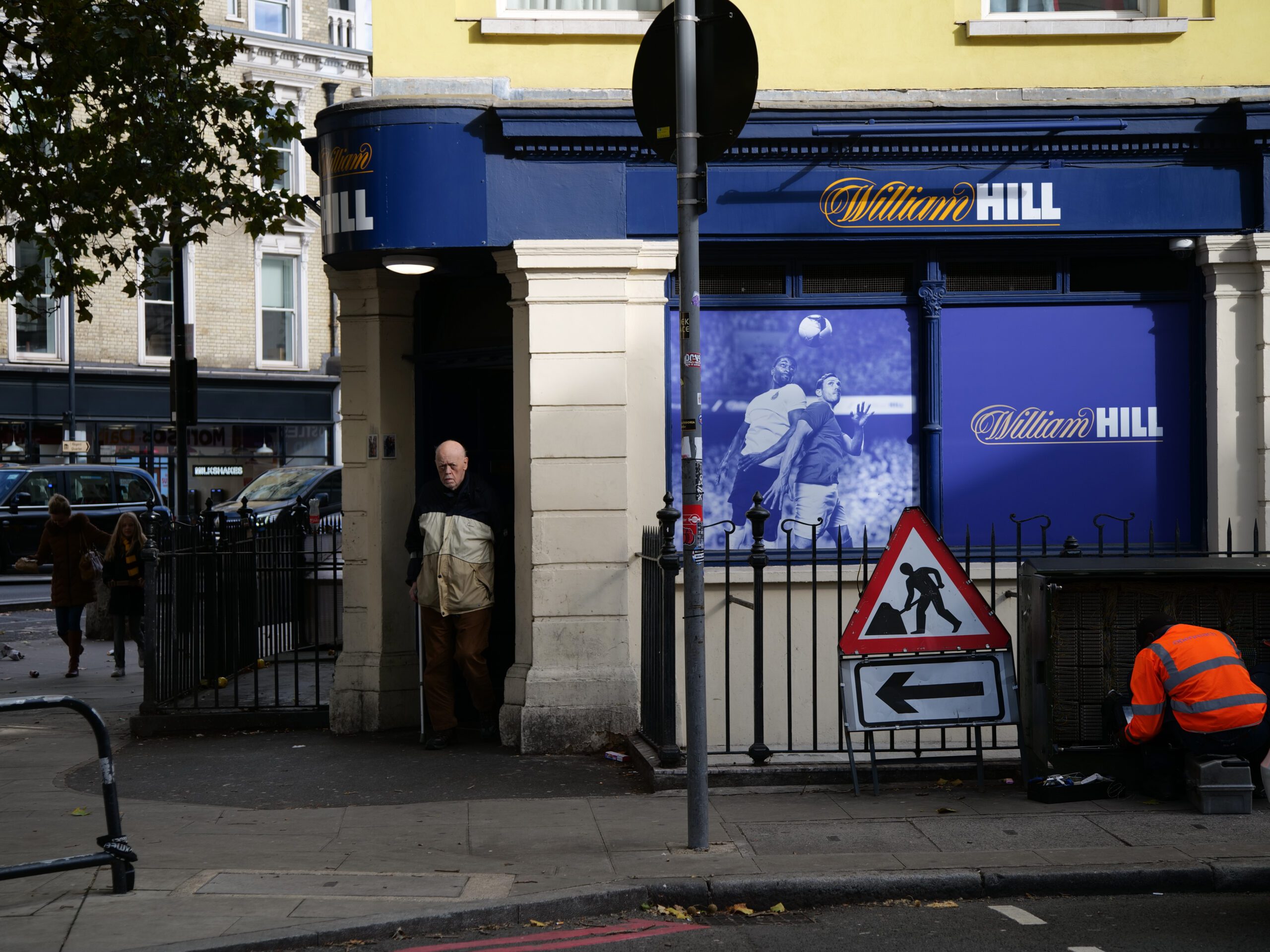
It was a deal that landed 888 Holdings with massive debt–currently estimated at £1.8bn (US$2.43bn)–to pay for the acquisition, led to the defenestration of CEO Pazner in a boardroom coup, and in a desperate bid to clean the slate a rebrand to “evoke”, with an on-trend diminutive lower-case “e” spelling.
Pazner, a gambling industry legend, who had served 888 Holdings in many executive iterations for some two decades, fell for the William Hill bait hook, line and sinker.
It’s a catch that has led to today’s crisis.
Not A Lot From Intralot
Now led by CEO Per Widerström, evoke yesterday confirmed in an official media statement: “[We are] in discussions with Bally’s Intralot S.A. (“Bally’s Intralot”) regarding a possible offer for the entire issued and to be issued share capital of the Company at a price of 50 pence per share (the “Proposal”).
“The Proposal is expected to comprise an all-share combination with a partial cash alternative.
“There can be no certainty that an offer will be made or as to the terms on which any offer might be made.
“Bally’s Intralot has confirmed to the Company that it will, by no later than 5.00 p.m. (London time) on 18 May 2026, being 28 days after the date of this announcement, either announce a firm intention to make an offer for the Company or announce that it does not intend to make an offer.
“This deadline can be extended with the consent of the Company.
Uncertain Future
Financial advisers Morgan Stanley and Rothschild & Co are acting on behalf of evoke.
Meantime, as for William Hill, evoke last month revealed that it is planning to shut 200 of the bookies as part of its ongoing retrenchment.
Bally’s for their part have issued no indication of how they see the future for one of the UK’s oldest betting brands.
It’s still early days.
Watch this space.