

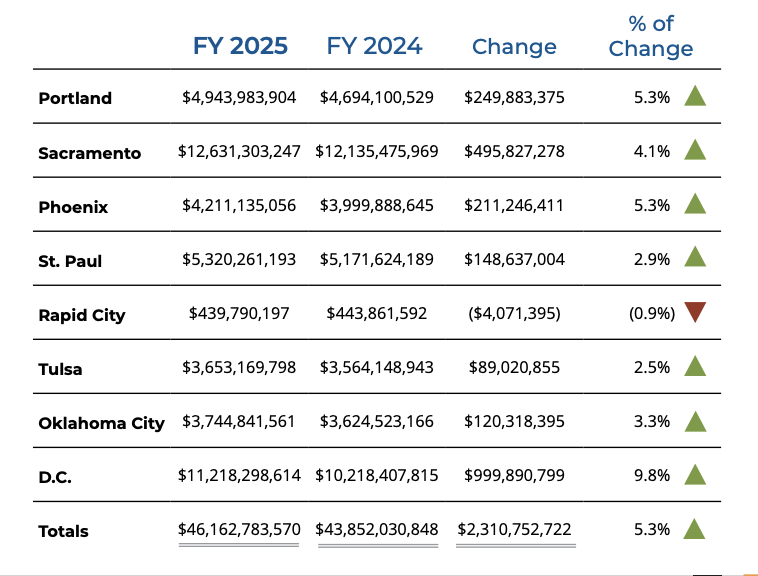
U.S. Tribal gaming has reached a new all-time high in fiscal year 2025, as gross gaming revenues (GGR) hit a record US$46.2 billion (£34.36 billion), according to figures released by the National Indian Gaming Commission (NIGC).
The impressive revenue haul marks a US$2.3 billion (£1.71 billion) year-on-year increase, or 5.3 percent growth over fiscal year 2024.
NIGC Associate Commissioner Sharon Avery, celebrating the sector’s performance, credited tribal regulators and operators for maintaining responsible growth across the sector:
“I would like to wish the Indian gaming community a job well done on another strong year,” said Avery.
“These GGR results reflect the continued commitment of tribal regulators and operators to responsible growth and community benefit.”
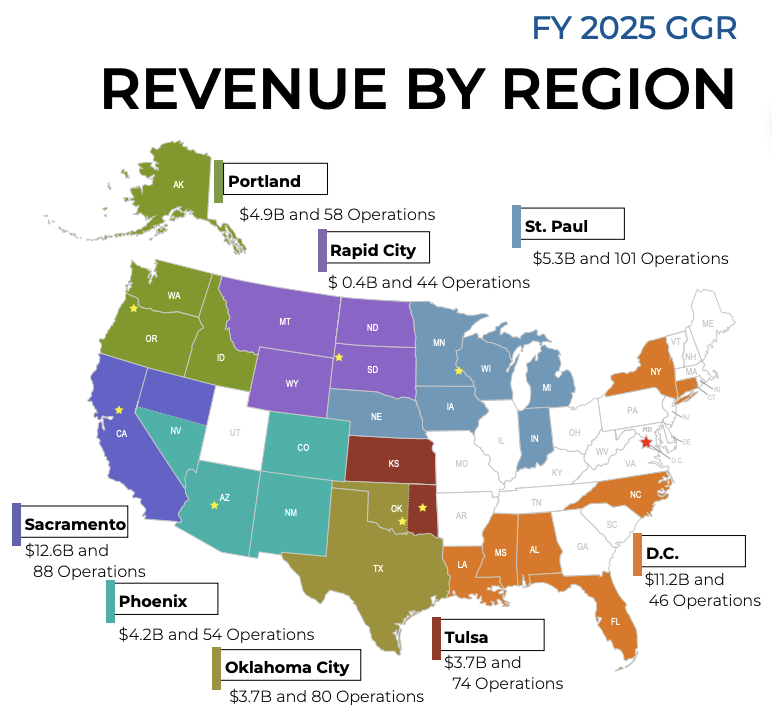 The total revenue comprises data from 545 gaming operations, run by 250 Tribal Governments in 29 states. For reporting purposes, these are split into nine regions.
Booming
Eight out of nine regions posted year-on-year growth, with the exception of Rapid City (covering South Dakota, North Dakota, Montana and Wyoming); where GGR declined by 0.9 percent.
The Sacramento region–covering California and northern Nevada–remained the largest regional market, with 88 gaming operators generating US$12.6 billion (£9.3 billion) in GGR, accounting for 27.3 percent of total Tribal gaming revenue.
Washington D.C. region–embracing New York, North Carolina, Florida, Alabama, Mississippi and Louisiana–ranked second, generating US$11.2 billion (£8.33 billion) from just 46 operators, making the geographic area one of the biggest markets in Native American gambling on a per-property basis.
This region also recorded the strongest annual growth, with revenue increasing 9.8 percent ,year-on-year.
This surge was likely supported by Florida’s contribution, given the Seminole Tribe’s position as the state’s exclusive online sports betting operator through Hard Rock Bet.
The latest annual NIGC revenue report also highlighted the concentration of revenue across the sector, with roughly nine percent of operators accounting for a whopping 54 percent of the total revenue generation.
Two Decades Of Growth
Tribal gaming is a considerable economic force in the U.S. and its benefits extend beyond reservations.
In 2025, the industry supported over 682,000 jobs.
Since 2006, the industry has doubled in size and, except for 2020, which saw widespread casino closures due to COVID-19, it has remained on an unstoppable year-on-year upward trajectory.
But Indian gaming is about more than just revenue generation. It’s also about local communities and development.
Tribal Learnings
As NIGC Vice Chair Billy Kirkland explained: “Indian gaming is an important contributor to Tribal economies that empowers sovereign Tribal governments to invest in their communities and provide their citizens with essential services.”
Tribal gambling represents around 59 percent of the USA’s retail commercial gaming revenue, which generated US$78.72 billion (£58.56 billion) in 2025 — up 9.2 percent year-on-year.
But the two sectors operate under very different economic models, especially when it comes to how that revenue is expended.
Rather than distributing profits to shareholders, Tribal gaming revenue is reinvested into funding Tribal governments and community development, directly supporting initiatives ranging from education and healthcare to infrastructure and economic development.
At a time when iGaming businesses are increasingly assessed by environmental, social and governance (ESG) and sustainability metrics, Tribal gambling is arguably a model of social enterprise that the wider betting industry can learn from.