Inside Brazil’s Betting Trends: Baseball Surges As Football Slips

Brazil is one of the most football-obsessed countries on the planet. But Blask betting data tells a different story.
In March 2026, baseball briefly became the second-largest betting subcategory in Brazil – a market where football is meant to dominate everything.
That spike wasn’t random. It points to something deeper about how Brazilian players search, choose and bet on sports.
And Blask’s non-branded search data shows how it happened and what Brazilian betting behaviour really looks like beneath the surface.
The Category Mix: Betting And Lottery First
Online Betting takes more than half of the total measured demand, with Lottery a clear second at 23 percent. Daily Fantasy Sports places third. Everything casino-related–Online Casino, Live Dealer, Poker–combined still falls short of the Lottery alone.
That doesn’t mean casino demand is small in absolute terms – it means it runs through branded queries. Brazilian players searching for casino products tend to go directly to operator names and branded searches don’t register in category-level data.
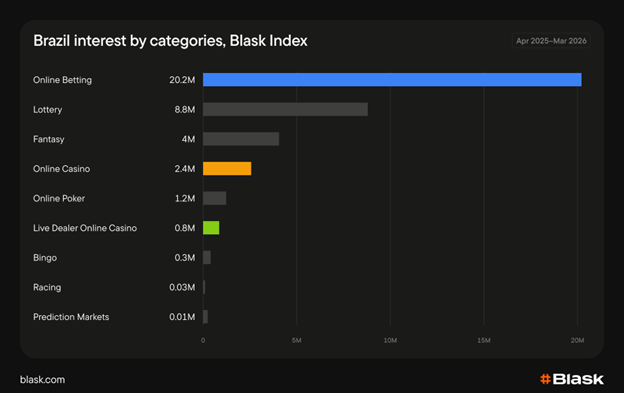
The organic, non-branded demand that Blask measures captures intent before a player has picked an operator.
At that level, casino sits at roughly 6 percent, which says less about the vertical’s real size and more about how players navigate to it.
The lottery’s second-place position reflects decades of state infrastructure. Caixa Econômica Federal has run Mega-Sena, Lotofácil and Quina since before most current operators existed.
For most Brazilians, the lottery was the first and only form of legal gambling they ever encountered.
Why Football Is Almost Invisible In Betting Searches
About 86 percent of Online Betting interest sits in a General Interest bucket – generic queries like “apostas esportivas” or “site de apostas.”
Football, as a named subcategory, accounts for less than 0.5 percent. That doesn’t mean football betting is small – it reveals that bettors already know where they’re going. They search by brand name or use generic terms rather than specifying the sport.
Esports and MMA both outrank football in subcategory volume because their audiences actually search for the sport by name.
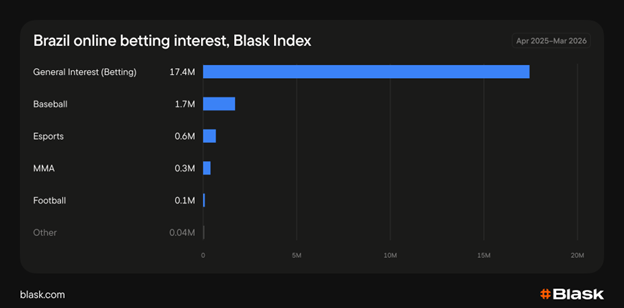
Baseball sits at second place with 17 times more search volume than football – partly for the same structural reason (baseball bettors search by sport), partly because São Paulo state hosts the world’s largest Japanese-Brazilian diaspora, with deep cultural ties to the game.
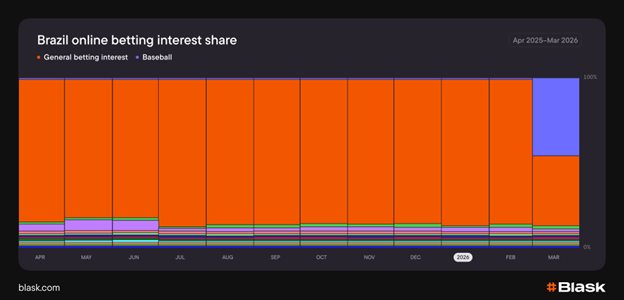
And in March 2026, baseball’s share spiked dramatically: Brazil qualified for the World Baseball Classic for the first time in years and played against top teams, including the United States, generating outsized odds and hype in betting lines.
A single tournament was enough to reshape the category share for an entire month.
Casino: Slots First, Crash And Plinko Behind
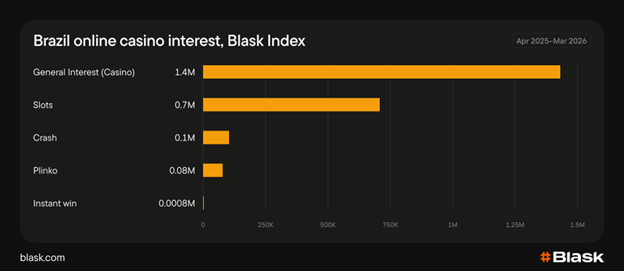
General Interest searches dominate the casino category at 60 percent, followed by Slots at 30 percent.
The more interesting signal sits further down: Crash and Plinko together account for nearly 10 percent of the category. Aviator and Plinko have built sustained search demand through influencer marketing and social media hype.
Live Dealer: Blackjack, Not Baccarat
Blackjack takes 71 percent of Live Dealer demand – well ahead of Game Shows, Roulette and Baccarat.
In Asian-influenced markets, Baccarat typically leads; in Brazil it sits fifth. Teen Patti and Andar Bahar are negligible, indicating no meaningful South Asian community imprint on preferences.
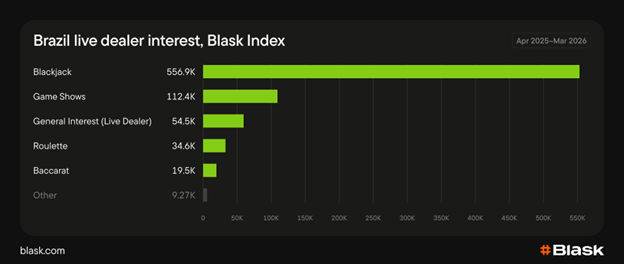
Blackjack’s dominance suggests Brazilian live casino players skew toward games that carry a perception of skill, or that operator lobby positioning shaped search behaviour over time.
Game Shows in second place reflects that format’s aggressive penetration across Brazilian-facing lobbies over the past three years.
Bottom Line
Sports betting dominance holds in Brazil, but the demand runs through generic and branded queries – not sport-specific ones. Lottery remains anchored by decades of state infrastructure, while casino activity is likely understated in non-branded data, but heavily shaped by local preferences.
On the surface, Brazil follows global betting patterns, but underneath the familiar labels, it follows its own logic.