With plans to double growth figures and expand into five new jurisdictions, including the highly anticipated Alberta market in Canada, 2026 is set to be an ambitious year for leading B2B iGaming provider Soft2Bet.
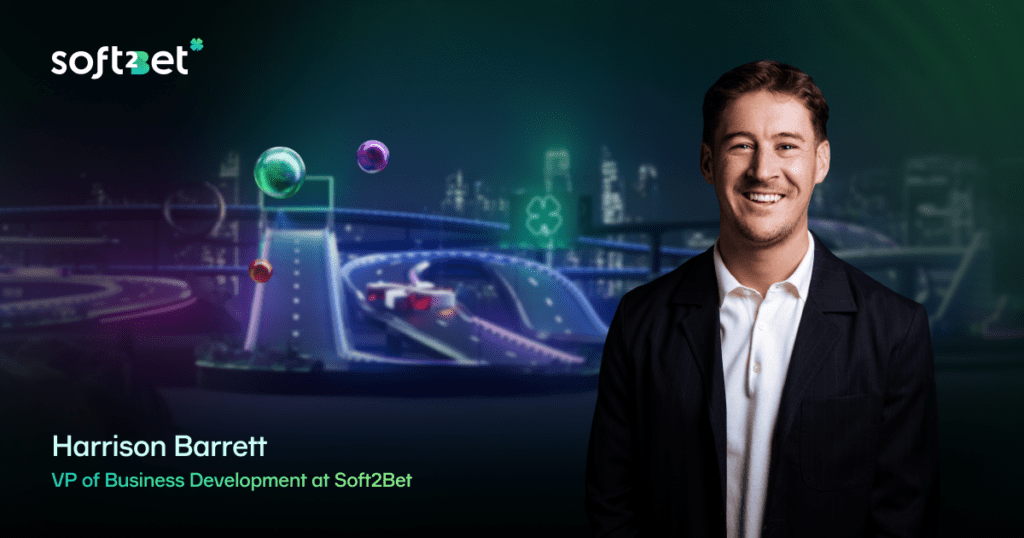
Despite the action-packed roadmap, Harrison Barret, Soft2Bet’s Vice President of Business Development, found time to squeeze in a chat with iGamingFuture’s Curtis Roach and share his perspective on where the industry is heading – and how Soft2Bet plans to stay ahead of the curve.
Harrison brings a decade of experience across the sector, including roles at DraftKings and Gaming Innovation Group. He has led partnership programmes through major regulatory change, supporting US IPO readiness and delivering more than €15 million (£12.9m) in annual revenue across European markets.
At Soft2Bet, he focuses on building Tier-1 partnerships and using data to scale the business across regulated jurisdictions.
Welcome Harrison.
In a recent Soft2Bet press release, the company described gamification as a “growth engine” rather than just a feature. How do you see gamification reshaping core product strategy for operators?
“I expect gamification to move from a set of add-ons into the core logic of how operators build products and drive measurable growth.
“The wider adoption curve is already obvious. Fortune Business Insights valued the global gamification market at US$6.33 billion (£4.7bn) in 2019 and projects it to reach US$37.0 billion (£27.6bn) by 2027, with growth continuing towards US$89.75 billion (£67bn) by 2031.
“In iGaming, the pressure to differentiate is even stronger because markets are crowded and the experience is increasingly mobile. EGBA reports Europe’s total gambling revenue at €123.4 billion (£106.5bn) in 2024, up five percent year on year, with online gambling nearing 40 percent of the market. By 2029, mobile is projected to account for 67 percent of Europe’s online gambling revenue.
“In practical terms, onboarding will feel less like a funnel and more like a guided first session, with missions and progression that help players understand the product and reach their first moments of value faster. Retention then becomes a steady cadence of goals, challenges and rewards that feel native to the brand, while working across the casino and sportsbook.
“To make this work at scale, gamification has to be measurable, fast to deploy and easy to localise. That is why we built MEGA as a standalone, API-ready layer with data-driven segmentation, flexible UX and market-specific configuration, so operators can personalise experiences, run meaningful tests, and clearly demonstrate uplift in engagement, retention and ROI across key markets.”
Soft2Bet is renowned for its high output in launching new brands. Which brands have debuted over the last few months, and what new features have been developed?
“Over the past few months, we have maintained momentum across both launches and upgrades. You have seen the debut of Swiper, the partnership between CampoBet Mexico and Diego Simeone, a refresh across CampoBet and Betinia, and the launch of Lodur for Swedish players.
“When we bring a new brand to market, we start with what makes it feel instantly familiar to local audiences. The identity has to be clear, the experience has to be tailored to the market and the mechanics need to create genuine reasons to come back from day one.
“Lodur is a good example of that approach. We integrated new mechanics at the core, with an experience built around missions, challenges and quests. This gives players a progression loop that stays consistent over time.
“Alongside the brand work, we have also announced three new MEGA engines, MEGA Round, MEGA Rally and MEGA Island. These are designed to support deeper personalisation, stronger engagement and a more local feel across casino and sportsbook.
“MEGA Rally, in particular, adds an event-led layer that is easy to communicate, encourages participation and gives teams performance signals they can track and improve.
“From a partnership and rollout point of view, it always comes down to execution. We look at how quickly we can integrate, how much control teams have by segment and market and what uplift we can prove.
“That is why MEGA is built to plug in via API, with segmentation, flexible UX and market configuration that make it easier to deploy, test and scale what works in key markets while improving ROI.”
MEGA Rally introduces a physical racing machine powered by neural networks, blending hardware, live streaming, and automation. Do you believe the future of iGaming engagement lies in hybrid digital-physical experiences, and is this just a signal of the broader, ongoing convergence between gaming entertainment and betting?
“I do think hybrid digital and physical experiences will play a bigger role, but only when they deliver something meaningful to both the player and the operator. If it is just a novelty, it will have a short shelf life. If it creates a moment that is easy to understand, easy to share and easier to trust, then it has staying power.
“For me, MEGA Rally is interesting because it addresses the trust gap directly. A lot of iGaming still asks players to accept outcomes they cannot see, even when the systems behind them are fair and heavily regulated.
“By moving from a hidden digital process to a visible physical machine, we bring a different kind of transparency into the experience. The player is not only watching the result, but they are also watching how the result happens, which changes the relationship from passive to informed.
“AI and automation then become enabling tools rather than the headline. They make it possible to run a physical concept reliably, at pace and with a consistent standard, while live streaming turns it into an event rather than a background mechanic. That is where I see the wider direction going.
“Betting and gaming entertainment are moving closer together through formats that feel live, social and verifiable. The operators that win will be the ones who can deliver that excitement with the right guardrails, strong compliance and clear measurement, so engagement remains sustainable and trust remains intact.”
Traditional loyalty programmes are increasingly commoditised. How do you see story-driven, progression-based ecosystems like MEGA replacing or redefining VIP and bonus mechanics in the next generation of casino and sportsbook platforms?
“High-value and loyalty programmes are starting to look interchangeable. When most operators rely on the same mix of tiers, cashback and deposit offers, the mechanics become expected and the differentiation disappears.
“What changes that is progression. A story-led journey gives players a reason to return that is not tied to a single bonus window. Missions, challenges and time-bound goals create momentum and rewards can be a blend of status, access and value. In that model, bonuses still have a role, but they support the journey rather than being the journey itself.
“That is where MEGA fits. It allows operators to build loyalty around behaviour and preference, not only spend.
“A casual sportsbook player can be guided through simple milestones on mobile, while a VIP can follow a more exclusive route with clearer targets and benefits. Because these journeys can be configured by segment and by market, teams can keep the experience local, stay compliant and measure what is genuinely driving retention and repeat activity.
“I do not see high-value players disappearing. I see it being redefined. Tiers remain important, but they work best as a layer within a richer experience that is easier to understand, better-paced and more rewarding over time. That is a stronger long-term answer than trying to compete on bonuses alone.”
As regulators and operators focus more heavily on responsible gaming, how can advanced gamification frameworks balance deeper engagement with ethical design? How can it help to ensure personalisation and immersive mechanics enhance entertainment without encouraging harmful behaviour?
“Responsible gaming and engaging design do not need to compete, but the balance has to be built in from the start. The strongest gamification shifts the experience away from compulsion loops and towards informed play, where players have structure, clearer choices and a better sense of pacing.
“A key part of that is predictive friction. If real-time behavioural signals suggest a player is moving into erratic patterns, the product should respond with subtle interventions that break harmful immersion without disrupting healthy play.
“That might mean slowing the flow, surfacing a reality check, nudging a limit review or making a cooling-off route easier to reach at the moment it matters.
“Personalisation also needs to change its purpose. It should not be designed to drive volume. It should reward sustainable play.
“Progress bars, missions and loyalty points can recognise positive actions such as setting deposit limits or taking planned breaks, which turn responsible gaming tools from restrictive barriers into a natural part of the core experience.
“We are already seeing the industry move towards targeted, behaviour-led interventions at scale. EGBA has reported that its members sent 22.5 million personalised and targeted safer gambling communications in 2021, reflecting a clear shift away from generic messaging.
“At Soft2Bet, we build for markets where trust and compliance are non-negotiable. MEGA is offered as a standalone, API-ready solution with data-driven segmentation, flexible UX and market-specific configuration, which gives operators the control to tailor journeys by segment and by jurisdiction while keeping consistent guardrails across rollout.
“When you combine that level of control with predictive friction and sustainable play design, immersive mechanics can enhance entertainment without encouraging harmful behaviour. Players still feel progress and purpose, but they also feel in control and that is what makes engagement last.”
Editor’s Note:
As iGaming markets become more saturated, it is harder than ever for operators to stand out – there is simply too much similarity between products and offerings.
For Soft2Bet, the answer is gamification, shifting from an add-on to a core part of how products drive growth. When done well, through narrative and progression, it offers a genuine way to stand out and engage players from the moment they sign up.
Importantly, this doesn’t mean novelty. It requires depth, material value and a player journey that consumers want to engage with and progress through over time.
But engagement, especially using player behavioural data, raises important questions: When does it cross the line into excessive or harmful play?
Harrison, like many, argues that engagement and responsible gambling should not be positioned to compete, but built in tandem.
In his view: “The strongest gamification shifts the experience away from compulsion loops and toward informed play, where players have structure, clearer choices, and a better sense of pacing.”
Soft2Bet’s answer is “predictive friction”, using real-time signals to introduce subtle interventions and maintain control.
Ultimately, the operators who win will be the ones who can deliver “excitement with the right guardrails”, ensuring engagement remains sustainable and trust is maintained.