World Cup Failed to Lift iGaming Demand in Most Markets
Blask data shows how user interest in gambling reacted to sport’s biggest event in June.
iGaming markets are often driven by the sports calendar. This year’s FIFA World Cup is being held in its widest format ever, yet in most countries player interest in gambling brands in June dropped compared to May. That held true even in many participating countries including two of the three host nations.
Where the demand fell
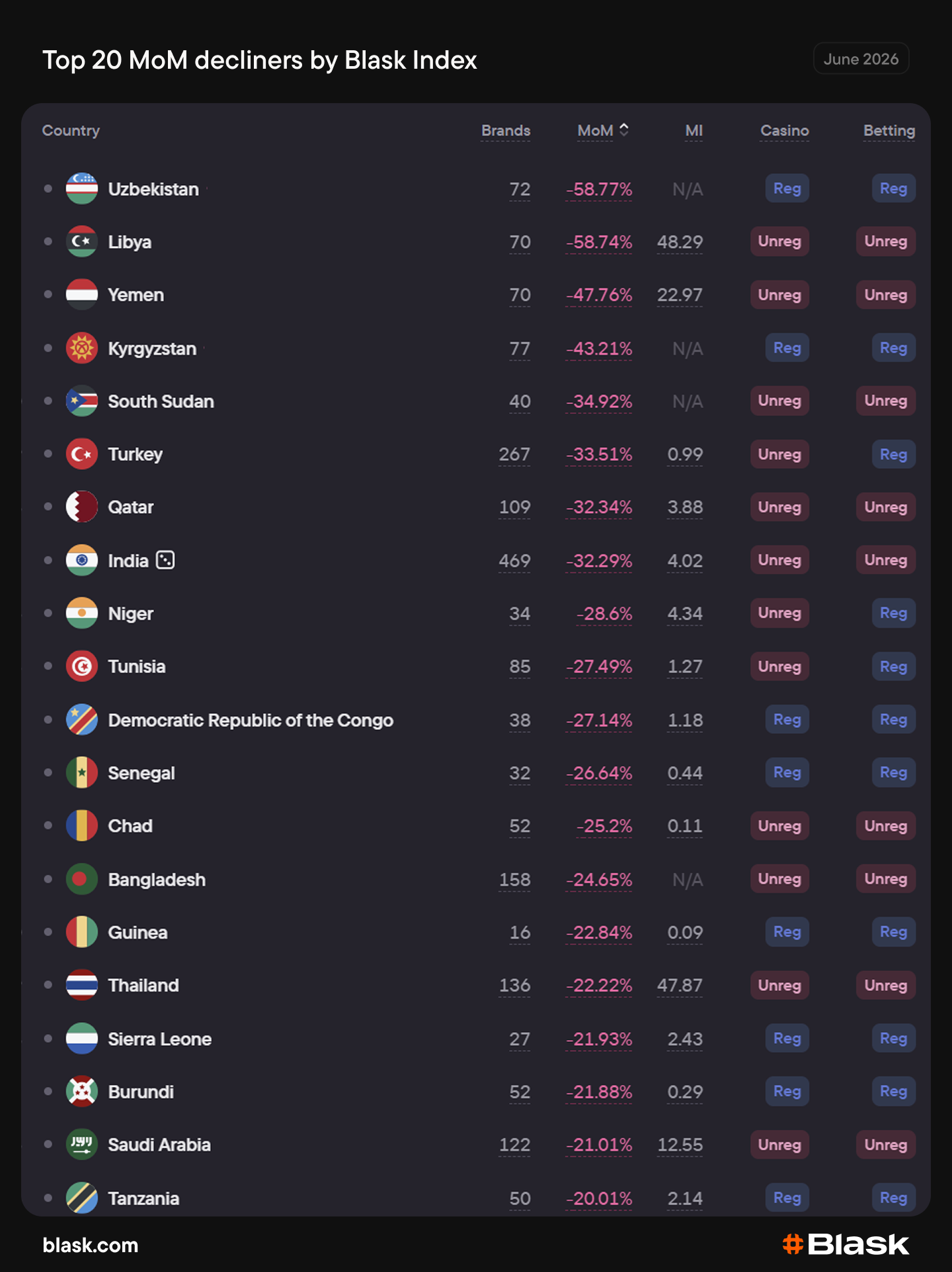
Blask measures users’ demand for iGaming brands with Blask Index — a real-time metric based on normalised search data. According to Blask, in June interest in online gambling dropped in almost three fifth of countries currently tracked.
The sharpest decline (−58.8%) was registered in Uzbekistan, even though it is the first Central Asian nation to reach the World Cup finals. The second-largest drop among participants (−33.5% month-over-month) came from Turkey.
Five more participating countries among the bottom 20 by monthly decline are Qatar, Tunisia, DR Congo, Senegal and Saudi Arabia.
The next weakest participating country by MoM Blask Index change is surprisingly one of the tournament hosts.
USA and Canada also declined
The United States is the biggest iGaming market globally. According to Blask, in terms of potential revenue, it surpasses the next 10 markets combined. And interest in the World Cup during June was huge in the US. Blask measured it with a specific metric — World Cup Index. Yet this interest did not fully translate into iGaming demand. The US Blask Index in June fell by 17.8% compared to May.
Not a single state showed growth in June, with the sharpest MoM decline registered in Wyoming (−72.2%). California — one of nine states hosting World Cup matches — fell the least (−1.7%), followed by New Jersey and Texas, which also hosted matches. Six other tournament host states declined from −10.7% (Florida) to −24.6% (Missouri).
A similar picture was registered in Canada, with the country’s Blask Index in June down by 8.4%, and not a single jurisdiction in the green zone. The only World Cup host country with positive Blask Index movement in June was Mexico.
Top gainers and surprises
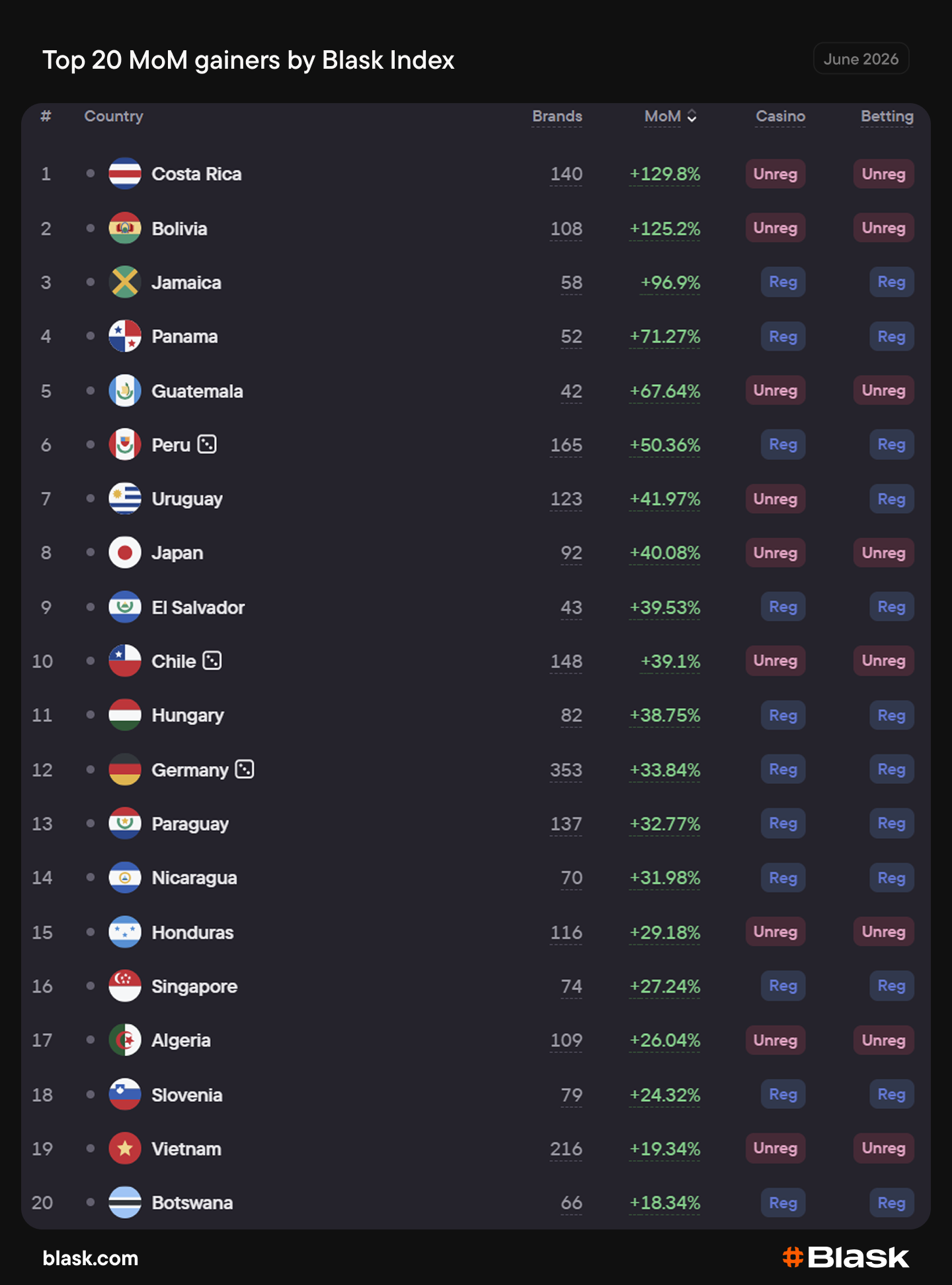
With a gain of 9.7%, Mexico ranks #33 out of 135 markets by Blask Index growth in June. Among the participating countries, it ranks #13, behind Austria, Belgium, South Korea, Ecuador, Argentina, Ivory Coast, Algeria, Paraguay, Germany, Japan, Uruguay and Panama.
Panama, though, even with a 71.3% rise in Blask Index, is not the top gainer among all countries. It sits only in fourth place, behind Jamaica, Bolivia and Costa Rica. That is likely a timezone effect, as nine of the top ten gainers are countries in the Americas. The only exception is Japan.
The strongest gain among European countries was posted by Hungary, which sits one place above Germany. The only other European country in the top 20 is Slovenia, which like Hungary did not qualify for the tournament.
One of the biggest surprises is Brazil’s Blask Index decline (−2.3%). The other is that iGaming demand in Italy (−2.3%), whose team failed to qualify for the tournament, fell less than in France (−3.3%) — one of the tournament favourites.
Bottom line
Big sports events like the FIFA World Cup are used by iGaming operators to attract new users. Blask data shows that interest in the event itself does not guarantee the boost in players’ engagement.
Author Credit to Blask